7 Things That Happen to Your Property When Trees Go Too Long Without Trimming
Most homeowners in The Woodlands, Spring, and North Houston do not skip tree trimming because they think it is unimportant. They skip it because nothing has gone visibly wrong yet. The tree is still standing. The branches are still green. The roof looks fine from the driveway. The problem with trees is that the damage they cause when they are neglected builds silently over months and years, and it announces itself at the worst possible time: during a storm, during a freeze, or on the afternoon when a branch that has been under stress for two seasons finally fails.
The seven consequences below are not hypotheticals. They are the documented outcomes of trees that went too long without professional attention on residential properties throughout Harris County and the surrounding North Houston communities. Each one has a specific cause that proper trimming would have prevented and a specific cost that proper trimming would have avoided.

1. Roof Damage from Branch Contact and Impact
The most direct consequence of untrimmed trees overhanging a roof is the damage that branches cause through sustained contact and impact events.
Branches that rest on or rub against a roof surface do not just add weight. They abrade the shingle surface with every movement, removing the granule layer that protects the asphalt underneath from UV exposure. A branch that has been resting on a roof section through multiple seasons has been sandpapering that section of shingles with every wind movement, every rain event, and every thermal expansion and contraction cycle. The result is a section of roof that has lost years of rated life through a cause that no storm produced and no inspection from the ground would reveal.
Impact damage is the more dramatic consequence. A branch that fails under wind loading, ice accumulation, or its own weight and drops onto the roof from even a short distance transmits significant force on impact. Shingle fractures, decking punctures, and structural damage to rafters are all documented outcomes of branch impact on North Houston residential roofs.
The trimming standard that prevents this: Maintaining a minimum clearance of at least 10 feet between branch tips and the roof surface eliminates sustained contact damage entirely and reduces impact risk by ensuring that branches must travel a meaningful distance before reaching the roof, giving wind events the opportunity to redirect them rather than allowing a direct drop from contact position.
2. Gutter Blockage and the Water Damage It Produces
Overhanging trees deposit leaf material, seed pods, pollen, and small debris into gutters continuously throughout the year. The loblolly pines, live oaks, and pecans common throughout The Woodlands and Spring produce high debris volumes across multiple seasons, not just in fall.
A gutter that is consistently loaded with organic material from overhanging branches cannot drain correctly during rain events. Water that cannot drain through a blocked gutter overflows the front edge, concentrates against the foundation perimeter, saturates the soil directly adjacent to the structure, and initiates the moisture intrusion cycle that produces foundation movement, basement moisture, and fascia rot.
The connection between overhanging branches and gutter blockage is direct: trees that are trimmed to maintain clearance above the roofline deposit significantly less debris into the gutter system below. Trees that overhang the roof deposit debris directly into the gutters with every wind event and every rainfall.
What sustained gutter overflow does to a Harris County property: Foundation movement in North Houston's expansive clay soils is expensive and progressive. Water that concentrates against the foundation from a blocked gutter does not drain quickly in clay. It saturates the soil, creates hydrostatic pressure against the foundation wall, and in the seasonal freeze-thaw cycle that North Houston experiences, applies frost pressure to foundation materials with each cycle. Foundation repair in the Houston metro area runs from several thousand dollars for crack repair to tens of thousands for piering systems depending on the extent of settlement.
3. Pest Highways Into the Structure
Branches that contact or closely approach the roofline, exterior walls, or utility penetrations of a structure create physical pathways that pests use to access the building interior. This is one of the most consistently documented but least considered consequences of untrimmed trees in residential settings.
The pests that use branch contact as a structural entry point in North Houston:
- Squirrels: Access soffit gaps and roof penetrations from branch contact points, establishing nesting sites in attic insulation that damage both the insulation and the structural components of the attic space
- Carpenter ants: Travel along branches that contact the structure and access wall cavities through gaps at roof and wall junctions, establishing galleries in moist or decayed wood that weaken structural members over time
- Rats and mice: Use overhanging branches as elevated entry routes to roof edge gaps, soffit vents, and utility penetrations, establishing interior nesting that produces structural damage, electrical hazards from gnawed wiring, and contamination of insulation
Pest infestations that originate from branch contact with the structure are not isolated incidents. They are access-dependent. The pest cannot use the branch pathway if the branch does not reach the structure. Maintaining branch clearance from the roofline and exterior walls eliminates the primary access route for the pest species most commonly responsible for structural intrusion damage in The Woodlands and Spring area homes.
4. Wind Load Failure During Storms
An untrimmed tree with a dense, unmanaged canopy functions as a wind sail. The larger and denser the canopy, the more surface area wind has to push against, and the more force is transmitted to the trunk, root system, and the structural unions between major scaffold branches.
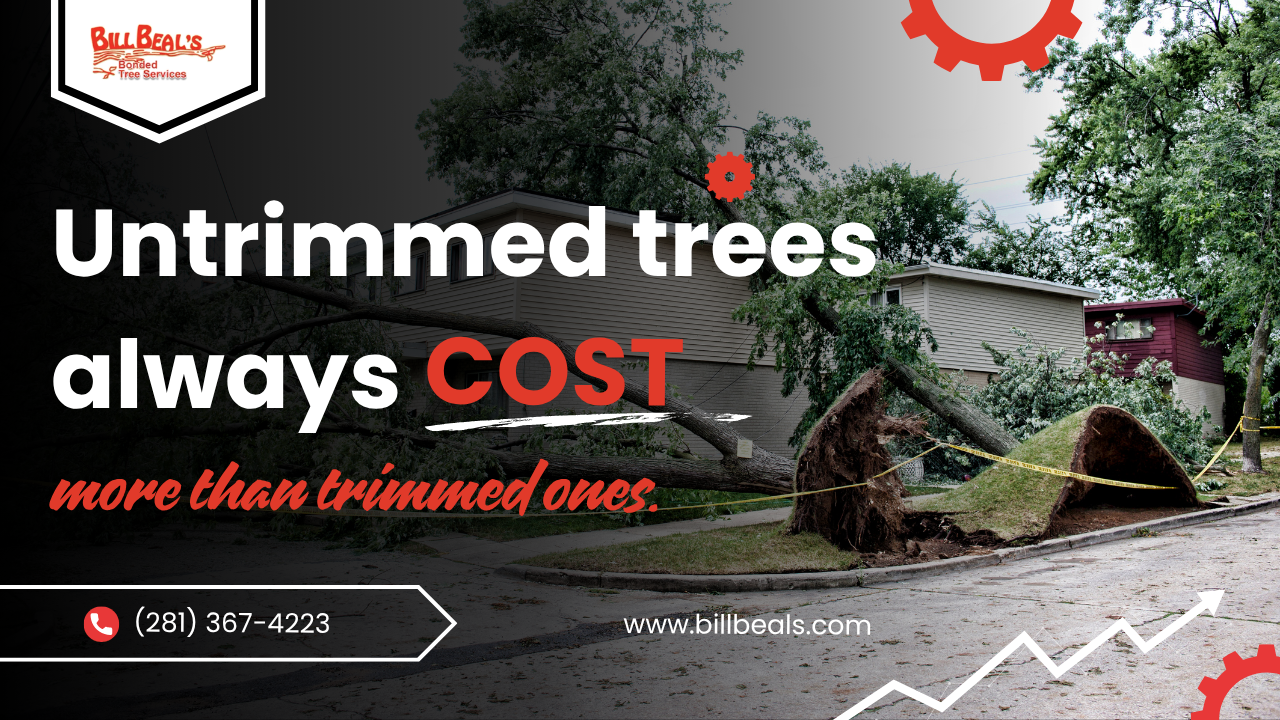
The North Houston area sits in the path of Gulf Coast hurricane systems, tropical remnants, and severe thunderstorm outflows that produce damaging wind regularly through the late spring and summer months. Hurricane Beryl made landfall near Matagorda in July 2024 and moved through Harris County as a Category 1 hurricane, with tree failures across The Woodlands, Spring, and surrounding communities accounting for a significant portion of the documented property damage and casualties.
What professional trimming does to reduce wind load failure risk:
- Canopy thinning: Removing interior and crossing branches to allow wind to pass through the canopy rather than pushing against it as a solid mass reduces the overall wind load on the root system and on structural branch unions
- End weight reduction: Removing weight from the tips of extended scaffold branches reduces the leverage force applied to branch unions during high winds, where the physics of a long extended branch multiply the force at the union point
- Dead wood removal: Dead branches have no structural integrity and become high-velocity projectiles in wind events. A large dead branch over a roof in Spring or North Houston is not a matter of if it will fail during a storm, but when.
A properly thinned canopy allows wind to pass through. A dense, untrimmed canopy catches it. This distinction is the difference between a tree that survives a Beryl-level event and one that adds to the property damage statistics.
5. Legal Liability Under Texas Negligence Law
This is the consequence that most homeowners in The Woodlands do not discover until after a storm has already produced a failure, and it is the one with the most significant financial implications beyond the cost of the physical damage itself.
Under Texas law, a homeowner's liability for tree damage to neighboring property depends on the condition of the tree before the damage occurred. According to Texas Law Help's verified legal guidance, citing Texas case law including Luther Transfer and Storage Inc. v. Walton and Hutchings v. Anderson, if a tree was decayed, diseased, dead, or in an otherwise dangerous condition before a storm, a homeowner may be held liable for damages caused by the tree's fall because the neighbor was likely negligent in maintaining the tree. If the tree posed an unreasonable risk of harm, the homeowner had a duty to trim the branches or remove the tree before the storm.
This is the legal distinction that separates an "act of God" insurance event from a negligence liability event in Texas: the condition of the tree before the storm. A healthy tree that falls in a storm is typically an act of God for which the homeowner is not liable. A dead, diseased, or unmaintained tree that falls in the same storm is a potential negligence liability because the homeowner knew or should have known the tree was in a dangerous condition and failed to act.
What this means practically for The Woodlands and Spring homeowners:
- A visibly dead or declining tree overhanging a neighbor's property or a shared fence line is not just a property maintenance item. It is a documented liability risk under Texas law.
- Regular professional trimming and the documentation of that maintenance by a licensed tree service creates a record that demonstrates the homeowner was exercising reasonable care.
- According to the ISA Texas Chapter, from 2015 to 2019 bodily injury and property damage was the second most severe category of homeowner's insurance claims, costing an average of $29,752. Tree-related bodily injury claims, while less frequent, fall in this category when negligence is established.
6. Foundation and Hardscape Damage from Root Encroachment
Above-ground branch problems are the visible consequence of untrimmed trees. Below-ground root problems are the invisible consequence that develops on the same timeline and produces equally expensive damage.
Tree roots follow water and oxygen. They grow toward the paths of least resistance, which in established residential neighborhoods in North Houston and Harris County include the gaps around underground utility lines, the joints in irrigation systems, the mortar joints in brick and concrete work, and the expansion joints in foundation slabs.
The root damage patterns most common in The Woodlands and Spring area:
- Sewer line intrusion: Roots that reach sewer lines enter through joint gaps and grow rapidly inside the line where water and nutrients are consistently available. According to the ISA Texas Chapter's guidance, trees including willows, hybrid poplars, and silver maples have root systems with the potential to invade sewer lines and drain pipes. Sewer line root intrusion that is not addressed progresses from partial blockage to complete obstruction, producing sewage backups that require both plumbing repair and root removal.
- Foundation slab movement: In North Houston's expansive clay soil, large tree roots that extend under a foundation slab extract moisture from the clay during drought periods, causing the clay to contract and the foundation to settle differentially at the root extraction zone. This produces the diagonal cracking patterns from door and window corners that are common in Harris County homes with mature trees in close proximity to the foundation.
- Hardscape lifting: Driveways, walkways, and patios in The Woodlands area are regularly lifted, cracked, or displaced by root growth beneath them. Hardscape repair costs vary by material and extent but consistently run into the thousands for meaningful surface area.
While root management is distinct from above-ground trimming, the above-ground canopy management that reduces a tree's overall size and water demand also reduces the root system's growth pressure and reach, making regular trimming part of the complete tree management approach that protects foundation and hardscape from root damage.
7. Accelerated Tree Decline That Ends in Emergency Removal
The final consequence of trees that go too long without professional attention is the acceleration of the decline process that eventually produces an emergency removal situation rather than a planned, cost-effective one.
Trees that are not professionally trimmed accumulate dead wood throughout the canopy over years. That dead wood is the entry point for the fungal and bacterial organisms that break down wood, and those organisms can spread from dead wood into adjacent living tissue at the branch unions. A tree that could have been maintained in healthy condition with regular trimming develops internal decay that progresses without visible symptoms until the canopy begins to thin, large dead sections appear, and the structural integrity of the trunk and major scaffold branches has been compromised.
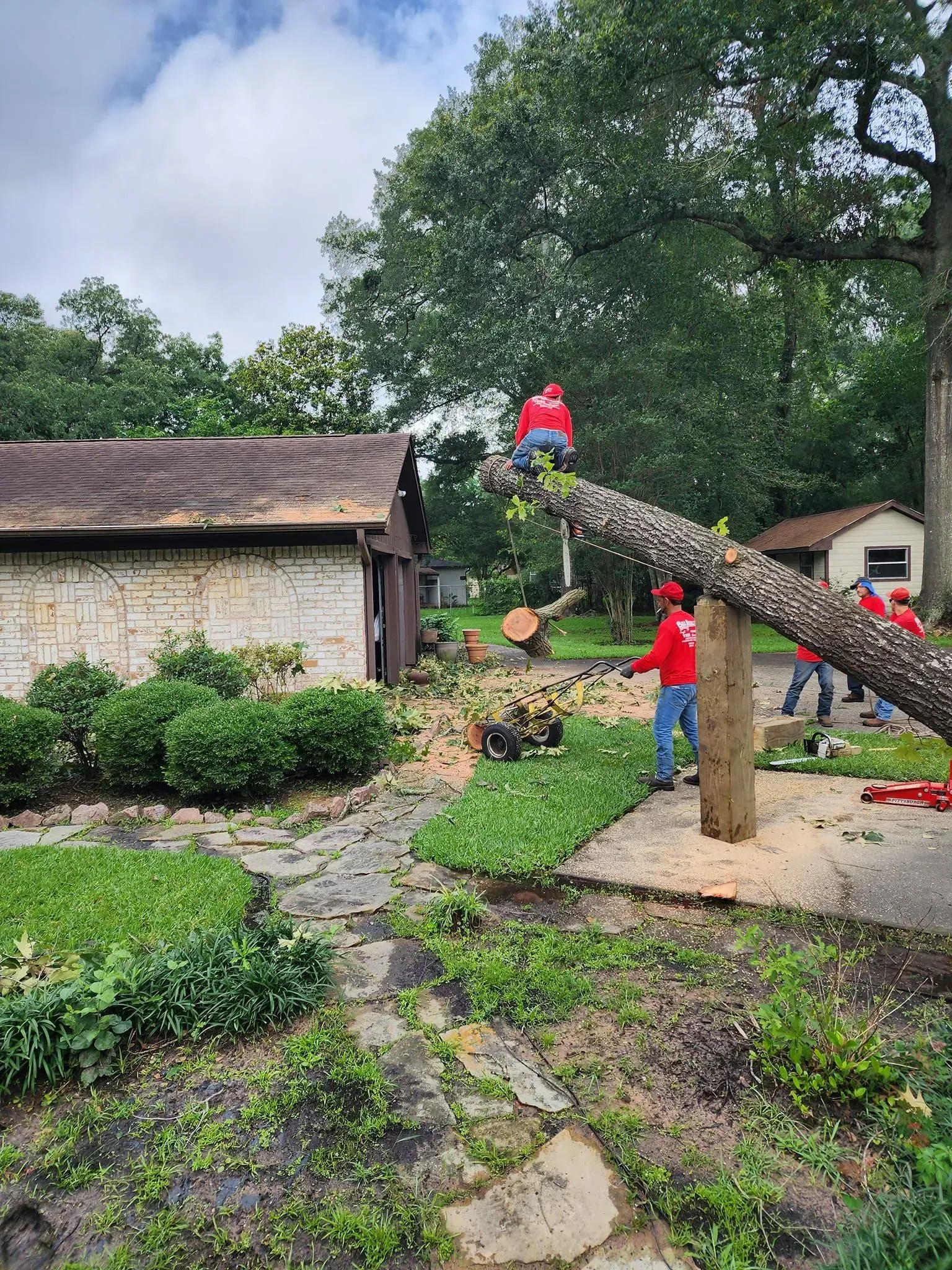
At that stage, the tree has moved from a trimming candidate to a removal candidate. And the removal of a large, structurally compromised tree in a residential neighborhood in The Woodlands or Spring, where the tree is adjacent to structures, over driveways, near fences and neighboring properties, is a technically complex operation that costs significantly more than the trimming that would have maintained the tree's health across the preceding years.
The cost comparison that makes the maintenance argument clear:
- Professional trimming of a mature tree in the North Houston area: typically several hundred to a few thousand dollars depending on size and complexity, performed every 2 to 5 years
- Emergency removal of a large structurally compromised tree in a confined residential setting: several thousand to ten thousand dollars or more depending on the complexity and access limitations
The homeowner who trims regularly is spending a known, manageable amount on a predictable schedule. The homeowner who defers trimming until removal is required is spending a larger, unplanned amount under time pressure with no opportunity to shop the job.
7. Accelerated Tree Decline That Ends in Emergency Removal
Bill Beal's Bonded Tree Service has served The Woodlands, Spring, and the surrounding Harris County communities since the 1980s. The team provides professional tree trimming, dead wood removal, canopy thinning, structural pruning, and complete tree removal for residential properties throughout North Houston.
Free on-site estimates are available for any property owner who has questions about the condition of their trees or the trimming they may need. The estimate covers what the inspection finds, what trimming would accomplish for each tree, and what the work would cost before any decision is made.